In the penultimate month before the festive season, during which I have not made a single Christmas purchase, here is my round-up as a coach, writer, and human being.
In my sixties, and it is all about clarity.
What I am craving now, in my sixties, to my surprise, is clarity.
It feels liberating because, as I reflect on the past decades, I can pinpoint a motivation, an overriding drive that shaped that part of my life:
In my twenties, right at the start of my career, it was all about money and financial security. I left Polytechnic as it was then, with a job as a graduate engineer in East London. Then, I spent six years bouncing around London, in shared accommodation, until I could afford to buy my own place.
In my thirties, everything was about time and flexibility. This was a period of juggling between further studies, starting my own business, and, towards the end of my thirties, becoming a mother for the first time.
In my forties, it was all about my energy and making the most of it. Perhaps not entirely surprising, given that I became a mother at the age of thirty-eight. My focus was very much on conserving it, trying to be more in flow while running my business and managing our family’s move to Brighton.
In my fifties, I was motivated by thoughts of legacy. What will I leave behind that is meaningful? What impact can I make with the time I have left? This ‘driver’ had an even stronger sense of urgency. I remember it felt all-consuming, guiding my attention to related resources, articles, and people.
So, it feels strange to recognise and admit that my main driver right now is clarity. Clarity of thought, purpose, and action. I might not have it in all areas of my life, but it is something I actively seek. And this might explain why the more times I circle the sun, the more I value those who can give me a clear, respectful no.
In fact, I’d go further and say I would prefer a hell no over a resentful and half-hearted yes.
And now I find I am also grateful to those people who are showing me who they are – to quote Maya Angelou:
When someone shows you who they are, believe them the first time.
It’s all about clarity.
I also found this fantastic post by Ellen Scherr on Substack, which speaks to this at a far deeper level – the neuroscience behind why you can’t pretend anymore.
Is it time for a revolution?
I think it might be.
Because I believe that, fundamentally, the world of work as I see it is broken; things as they stand are not working, not fully serving the society within which we live.
So I will reshare a quote from Benjamin Seebohm (1871 – 1954), an English sociological researcher, social reformer, industrialist and second son of Joseph Rowntree:
Business has a soul; it is not a mechanical thing but a living and worthy part of the social organism. It is not an end in itself, but a means to an end and that end is the well-being of the whole community – Benjamin Seebohm Rowntree.

I can’t help but wonder how many businesses and organisations out there have a soul. How many are a worthy part of the social organism, serving the communities within which they are based?
Questions I have been pondering on since I first saw the quote at a Joseph Rowntree Foundation online event about poverty a few years ago.
It also got me thinking about how we value certain types of work over others. Why are so many people working full-time yet still struggling to build a good life?
So, I think it might be time to turn the world of work on its head and find ways to make it work, not just for the few, but for everyone. AI could potentially play a major role in this for good or ill; I’m still undecided on which way it will ultimately go.
And with the world’s first trillionaire and the increasing number of billionaires, it is clear to me that this isn’t a matter of a lack of wealth but rather of where that wealth is concentrated.
There seems to be a general lack of soul.
I’m including links about the increasing number of billionaires here amd here.
We’ll be back in 2026
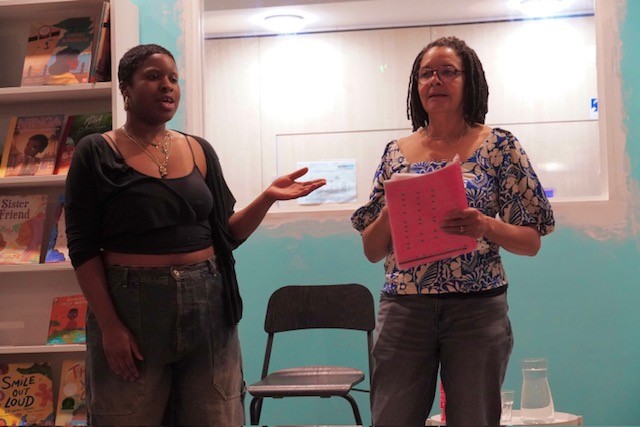
The eagle-eyed among you may have noticed that there was no Off the Page, Open Mic at Afrori Books in October.
Maybe it’s the time of year, but it had begun to feel a little like pushing a large boulder up a very steep hill – so Oliviyah and I have decided to press pause. So we can rest, review and most definitely relaunch in 2026.
We remain committed to building a community of writers around the Open Mic events, and taking a pause will allow us to plan and return refreshed with a broader range of events. We are excited to see how the Open Mics evolve, especially now that we are part of the #BrightonBookFestival.
But for now, it makes sense for us to conserve our energy and take the rest we need.
And to slightly misquote, Arnie – ‘we’ll be back.’
The Terminator is still one of my all-time favourite films.
My hunch about loneliness within our universities
Something is happening within our UK universities – something that doesn’t feel right, and it has been that way for quite some time. My instinct is telling me that something is wrong, something is amiss, and it deserves closer examination.

I am, in truth, relying on anecdotal evidence, drawing on my observations and conversations with family and friends as they describe their experiences of university life.
So my latest post on Pittabread is based on these limited observations and some research conducted using ChatGPT.
So, to start, I believe that many of our young people at university lack a genuine sense of connection and belonging, despite growing up in an increasingly digitally connected world; something appears to be missing at the heart of it all.
For a digitally connected, social media-savvy generation, I remain unconvinced that our Gen Zs have the opportunities they need to feel they belong.
I suspect that the opportunities, skills, and time to develop and sustain ongoing relationships, friendships, and community while at university are diminishing, and I think there are six reasons for this.
Firstly, students do not appear to meet regularly in person with the same group during lectures. The Pandemic is behind us, but online classes continue. I’d like to know the general ratio of face-to-face to online sessions.
To read the rest, please click on the link – because, in my opinion, something isn’t quite adding up, and I am genuinely curious to know if it’s just me.
Until next time