
Another dose of Optimism and Hope
That’s what I have found in Rutger Bregman’s third book, Moral Ambition – How To Find Your Purpose. A book, I believe, written to help those looking for ways to roll up their sleeves and solve problems, whose solutions would go some considerable way towards making the world a better place.
As the world around us seems to be imploding a little right now, I actively seek out pockets of hope and optimism, and I’m so glad to be starting 2026 with this book in my hand.
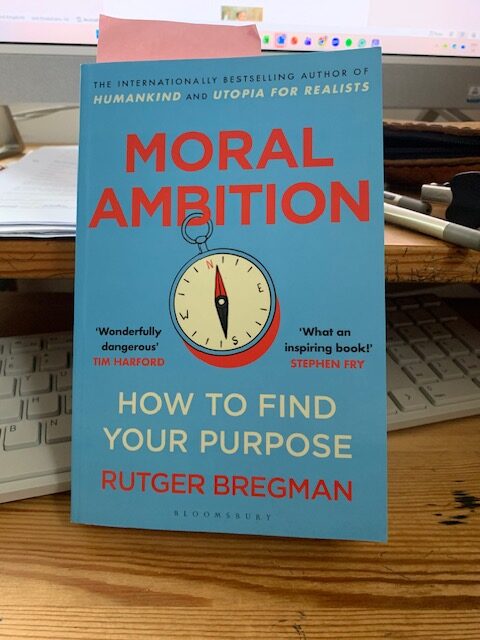
I’m only a third of the way through, but I was blown away to discover there is a school for social entrepreneurs – physically based in Kilburn, North London, that trains and supports people who want to roll up their sleeves and apply their skills and talents to making the world a better place.
It seems that their application process will start again in February:
From what I’ve read, the application process is rigorous, but if you are successful, you spend two months working through the programme full-time with an assigned mentor on an assigned problem.
I can’t tell you how excited I am about this discovery. I can see enormous potential. There must be others in my network who this would appeal to. I am wondering whether this could be a way to start an amazing career, rejuvenate an existing one, or even close one.
So, what problem would you tackle and rid the world of if you had the resources and a team behind you?
You have one life, let’s go make it count – Rutger Bregman, Moral Ambition.
I just need to work out how. 😉
Drama, judgment, or advice
What do you get when you share a piece of sobering news with someone?
People often mean well, but there are times when you don’t need any of the above; you just need to be heard. You need someone to sit with you awhile and attend to what you are saying without jumping in with suggestions, tips, guidance or their perceived wisdom. You need the emotional space to talk through your feelings and fears, knowing that you are with someone who will sit with you awhile.

How do you react when someone shares sobering or bad news? Do you find yourself rushing in with well-meant advice, or is it somehow turned into a big drama about you? Sometimes when we share some big news, this is what we are offered.
And I heard myself doing precisely this with a long-standing friend and colleague – who, as I recall, was incredibly patient while I finished speaking at them. I meant well, but in my initial fear and panic, I was not actually listening.
So, I need to remember to ask myself – before I speak, am I ready to listen deeply, or am I about to step in with drama, judgment, or advice? Or, worse, unasked-for coaching 😉.
Until next time
PS
I am now playing and sharing more on Substack, and although it’s a work in progress, I’d love to see you there.
Who is working for Henry VIII today?
An odd question? Perhaps, but bear with me as I take you through my thinking, as I am currently reading Hilary Mantel’s Wolf Hall, a book I have read countless times.
But each re-reading always yields fresh insights and perspectives, and this time I have been struck by the parallels between the downfall of Thomas Cromwell (the book’s main character) and that of his mentor, sponsor and employer, Cardinal Thomas Wolsey.

In their dealings with Henry VIII, Cardinal Wolsey could not deliver the King’s separation from his first wife, Katherine of Aragon. In the case of Thomas Cromwell, he arranged Henry’s marriage to Anne of Cleves, Henry’s fourth wife, which displeased Henry and had disastrous consequences for Cromwell.
Though Wolsey managed to avoid the axe, Thomas Cromwell was butchered at the end by an incompetent axeman. I can’t help thinking that Cromwell might have preferred to have outsourced this himself (IYKYK).
Which brings me nicely to my question – who is working for Henry VIII today?
Because I wonder how many organisations treat their staff in a very similar way, seeing them as easily expendable. Once they are no longer perceived as useful, they are treated with little thought or care for their fate. Their fall or loss of role appears almost out of nowhere, all in the name of cost savings or increased profits, or, with a wringing of hands, ‘it’s because of AI, don’t you know. ‘
Organisations that axe their employees almost at the drop of a hat, with little thought or compassion, once staff are deemed surplus to requirements, no longer considered to be needed.
So, is there a better way?
I sincerely hope so.
Until next time.
PS And if you imagine I am letting Cromwell off the hook, you can read more here:
Until next time.