During the month of the festive season, here is my round-up as a coach, writer, and human being.
Opening my world to new possibilities
As we approach the end of 2025, what do you want to leave behind? What do you need to pause, and what would you like to take forward into 2026?
I’ll come clean; there is one significant thing I am ready to step back from in 2026, as I create even more space for writing and exploring the myriad ways I can repurpose the articles I have already written and shared.
I am not entirely sure what 2026 will bring, but how many of us have such a clear picture anyway? One thing I am sure of is that it will continue to be a time of exploration and creation in one form or another, including:
- The return of our ‘Off The Page’ Open Mics, in partnership with the Brighton Book Festival, at Afrori Books, Brighton.
- Continuing to grow my presence on Substack and Medium, the platforms for writers, especially now that Medium is offering online writers’ circles. Not sure quite where LinkedIn is going, but it feels like the right time to branch out and build alternative communities.
- Hosting a few more online Open Mics – I believe there is some real potential here.
- Continue with the Tuesday morning, ‘Women’s Journaling and Writing Circle’, founded and facilitated by the fantastic duo @JackeeHolder and @FionaParashar. I’ve signed up for their ‘Welling Up’ virtual retreat on Tuesday, 13th January – because what better way to start 2026?
- A few additional guest appearances on podcasts.
And I am going to put this out there, get Thin Sandwich out into the world. It’s about time.
But for those of you looking to broaden your horizons, here is my article on opening your world to new possibilities.
So, to quote Mary Oliver:
Tell me, what is it you plan to do with your one wild and precious life?
Utopia for Realists
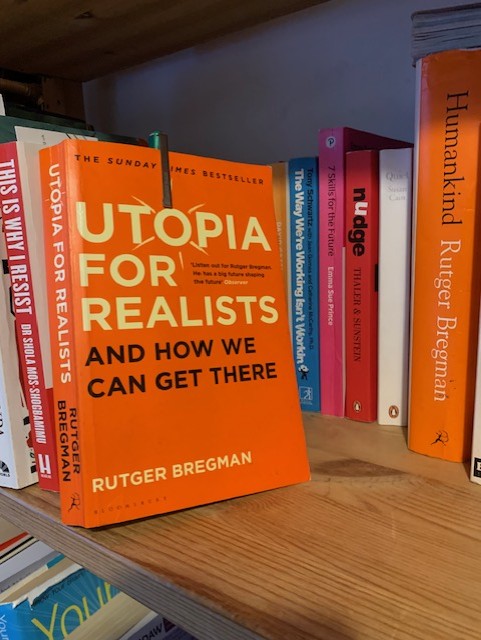
Whenever I feel in need of a dose of optimism and hope, one of the things I reach for is Rutger Bregman’s Utopia for Realists. A book that advocates for Universal Basic Income, open borders and a shorter working week.
I have said this before; maybe it is time for a revolution, a time for change. The world of work, as I see it, is essentially broken, unsustainable in its current form, and generative AI is only part of the story.
And I am entirely on board with the book’s premise:
‘This book isn’t an attempt to predict the future. It’s an attempt to unlock the future.’
So, I must ask, what could we unlock if we eliminated poverty? How much human potential, talent, joy, creativity, ingenuity, and laughter is currently trapped and buried within poverty? Because I firmly believe that poverty is entirely man-made; there is nothing natural or divine about it. And if that is true, the good news is that it can be unmade.
Are we as a society blaming those who don’t have the resources the rest of us have? Who deserves a good life? Who deserves to have choice and freedom?
Are we in fact currently waging a war on the poor rather than on poverty itself?
So, I, for one, will be tuning into this year’s Reith Lectures, Moral Revolution, delivered by the Dutch historian Rutger Bregman, where he explores historical movements and modern challenges to spark positive change through a series of four lectures:
A time of monsters – aired 25th November
How to start a Moral Revolution – aired 2nd December
A Conspiracy of Decency – aired 9th December 2025
The Strange Shape of our History and Future – due, I believe, to be aired on 16th December 2025
I hope to be uplifted and energised by the series, but more than that, I am looking for ways to act and wage war on poverty.
And I’ll close with this quote:
‘Poverty is fundamentally about a lack of cash. It’s not about stupidity. You can’t pull yourself up by your bootstraps if you have no boots – Joseph Hanlon, cited in Rutger Bregman’s Utopia for Realists.’
In search of my random creativity
Six years ago, in May 2019, I attended a presentation on positive psychology, one of the monthly meetings organised by the Brighton and Hove Psychology Networking group. During this interactive and highly engaging session, we were asked to turn to our neighbour and discuss, ‘identify and talk about one of your strengths.’
I immediately turned to my neighbour and said, ‘random creativity’ — a phrase that had been rattling around in my head. At that time, I believed it was a direct result of my Dyslexia, enabling me to combine seemingly random ideas and approaches. Like many others, my best ideas often emerged from nowhere when I allowed myself to daydream and my mind to wander.
Fast forward to 2025, and I now realise how much I took my random creativity for granted, nearly to the point of complete depletion. Thank you to those friends and colleagues who suggested that I work through Julia Cameron’s — The Artist’s Way, because without it, I might not have realised just how depleted and drained my store of random creativity had become.
I would not have recognised the importance of refilling and replenishing my creativity, or of actively nurturing the artist within me – probably because I believed this didn’t apply to me or my life. It would have seemed too ‘woo woo’, too out there for someone like me.
Because, without fully realising it, my ideas for stories, articles, posts, quirky thoughts, and random pattern making had gradually begun to dry up. I still cannot identify exactly when this started. But I suspect it was at some point during the Pandemic, when I was too busy professionally and personally to worry overmuch about writing stories.
But now, as I move into the next phase of my life, it may be time to take myself more seriously as a creative being and finally take ownership of my random creativity, paying it the respect it deserves. I think it is time for it to occupy centre stage, rather than being stuck on the fringes of my life.
To see if I find it, please visit my Medium page😊:
So, I am intrigued. What did you almost allow to slip out of your reach?
Until next time